Improving your period home with traditional wood floors
Traditional wood floors in a period property are a natural choice – but they’re also an elegant and practical one. Wood floors are popular for a wealth of reasons: they enable you to make the most of your home’s original features and showcase its period charm, while also giving you durable flooring that stands the test of time.
When decorating or renovating a period property, one of the first decisions you’ll likely make is how many of the original features you’re going to retain and how much you’re going to modernise. The most practical answer to this is usually a mixture of both. Combining old and new carefully – balancing the traditional with the contemporary – will give you a beautiful home that’s a pleasure to come back to every day. So, how should you choose wood flooring for your period home?
Traditional wood floors for large and small spaces
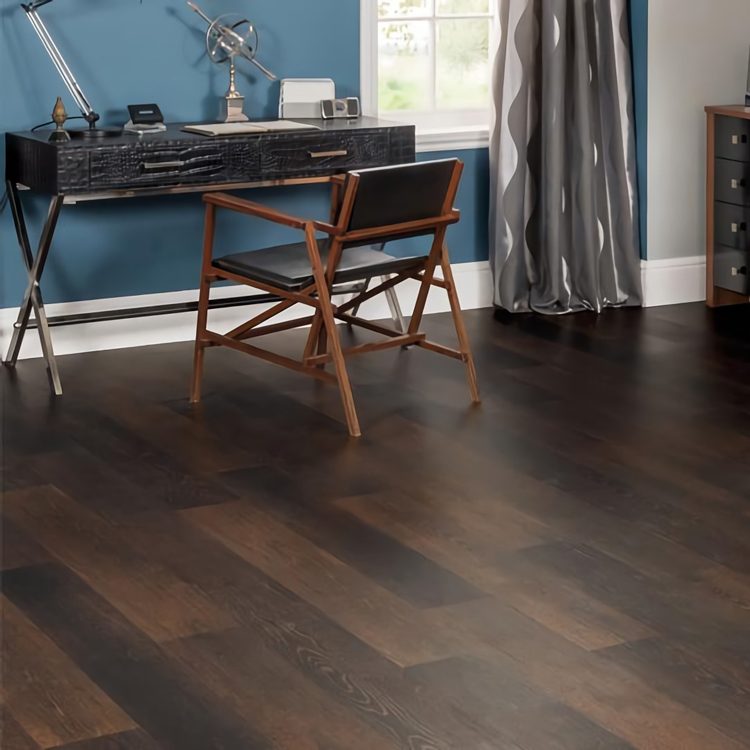
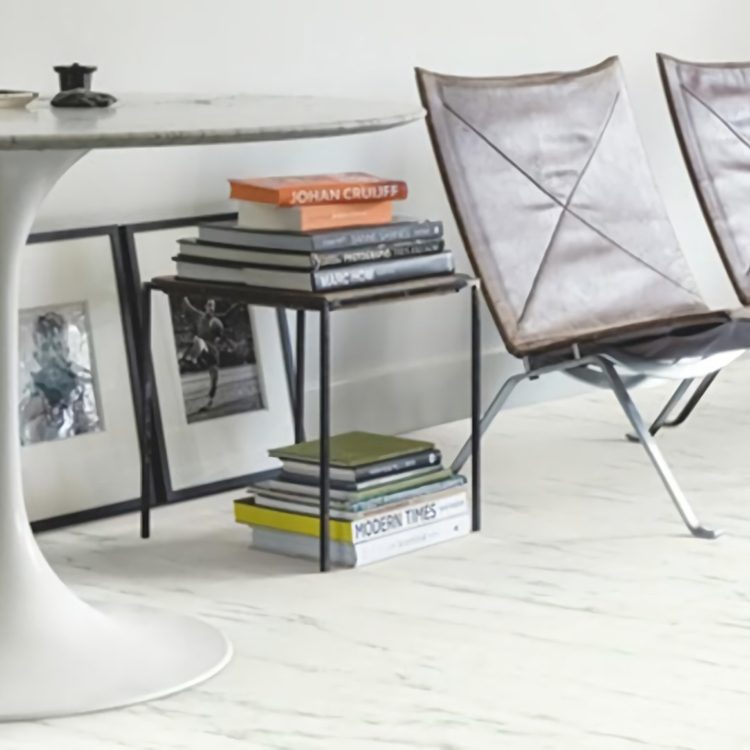
First, consider the size of your home overall, as well as the space where you’re planning to lay wood flooring. In a larger period property with spacious rooms, pale-coloured wood flooring will enhance the sense of light and space, and make your home feel open and airy. If your period home has large windows with plenty of natural light, you can afford to be bolder with colour choices and create cosy spaces with strong hues and dark wood flooring.
In larger spaces, you can also create different zones by laying the same wood flooring but in different laying patterns. For example, a herringbone floor with a matching border detail could be laid in a formal reception room or hallway, and then in an adjoining room, a matching plank could be fitted. This technique works in smaller homes too, providing continuity, flow and visual interest as you move between rooms.
In smaller period properties, using pale or medium-coloured wood flooring will give the impression of light and space, but you don’t have to be restricted by that. Traditional wood floors in a warm-toned dark colour will make small rooms feel homely and welcoming. If you are looking to create the illusion of more space, however, choose wide, straight planks, rather than narrow planks laid in busy patterns that are not uniform in colour. Smaller-scale herringbone flooring is best suited to smaller areas and rooms, while larger-format herringbone is best suited to bigger rooms.
You may discover that a previous owner of your home has covered original wood flooring with carpet or vinyl. If the flooring has suffered slight damage or has been neglected, it can usually be restored using modern pigmented oils, which will update the shade to complement your chosen colour scheme.
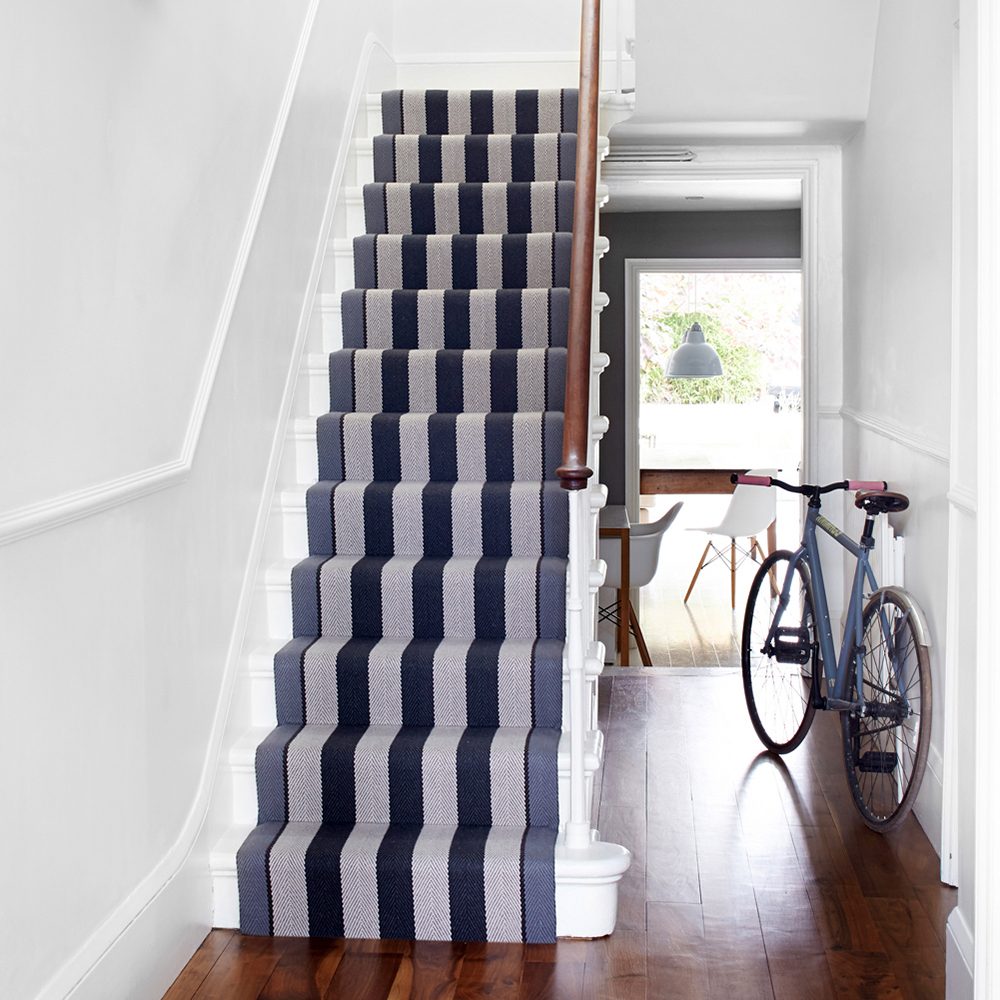
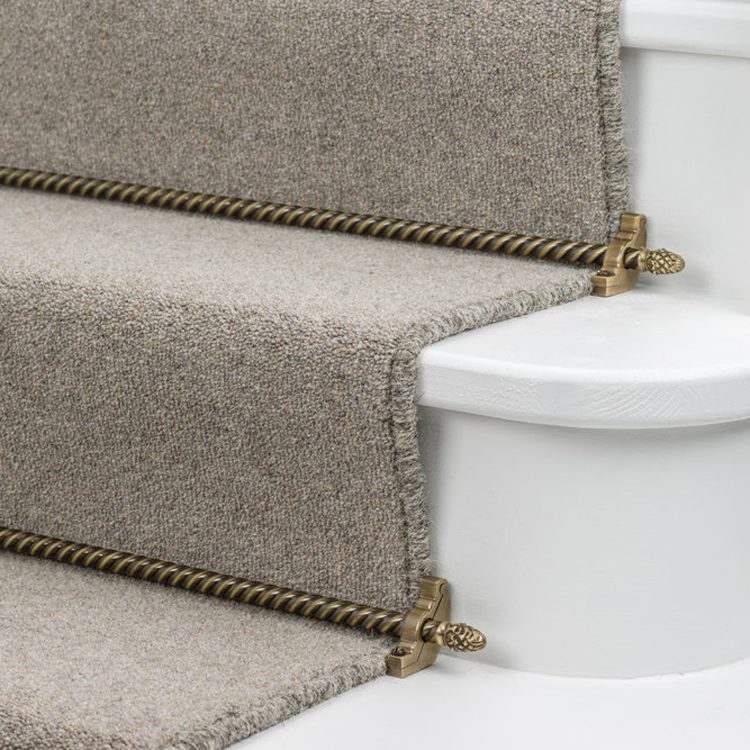
To make a room feel warm and welcoming, a well-chosen rug will add comfort while bringing a design scheme together. For timber staircases, a traditional stair runner is the perfect fit for every period home.
Traditional wood floors from Higherground
Here at Higherground, almost all of the wood flooring we sell is oak, the only exception being American Black Walnut – see our Vienna or Deco Plank flooring styles.
People tend to think of oak as a honey-coloured timber, when actually it is very pale, like parchment. If it has a golden colour, that will have come from a lacquer or an oil. Traditionally, these treatments gave a warm, rich hue, but this has become less desirable in recent years. One of the many wonderful characteristics of oak is that when unfinished, it can be used as a blank canvas for all sorts of colours. And over the last decade, the demand from discerning homeowners has increased for timber floors in a wider variety of shades, and the market has responded by creating oils and stains in almost every conceivable colour.
In terms of durability, there’s no difference between solid wood and engineered wood flooring. Engineered boards can be made wider and longer as they are more stable, and don’t tend to shrink or cup, unlike their solid counterparts. We offer solid wood floors but only in the more traditional small parquet format, where these shortcomings don’t pose an issue.
Wood flooring in real homes
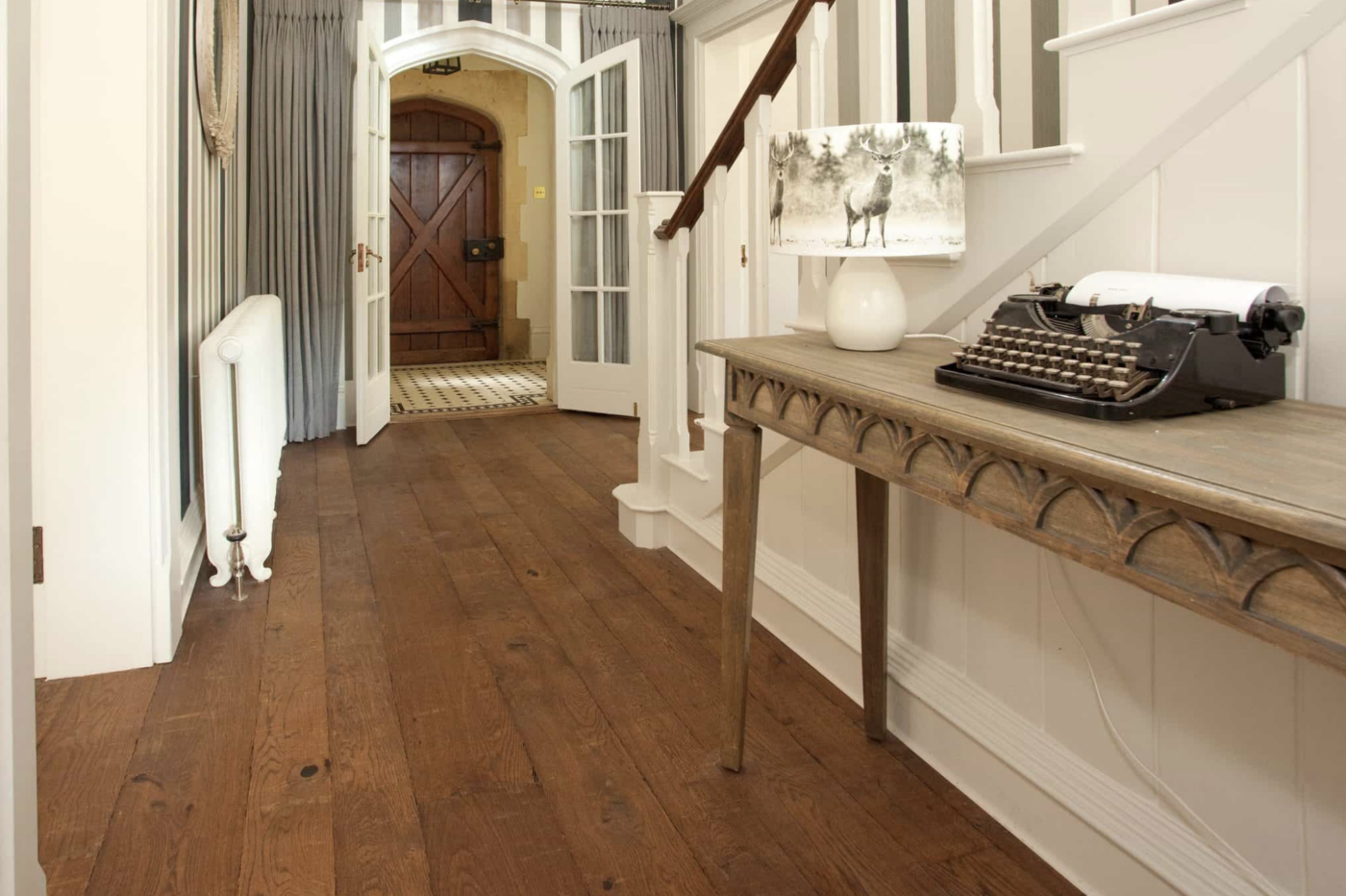
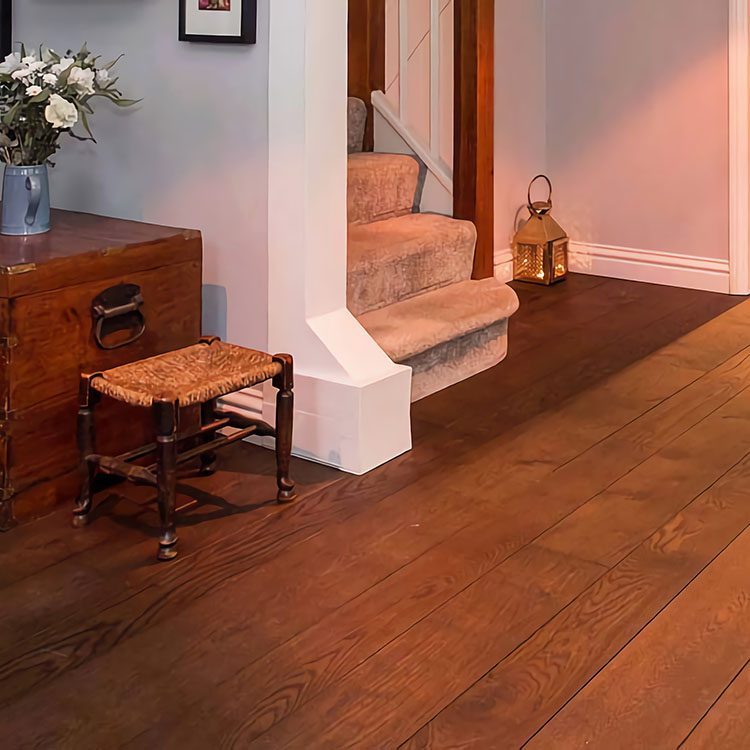
In this large period home, our York Old English flooring was chosen to create a traditional look. This flooring is multi-width, combining three widths to recreate the look of an original floor. Prior to the mid-nineteenth century, when trees were felled, they were cut randomly to size, not in the regular board widths that are commonplace today.
To add further authenticity here, the boards have been aged and distressed to provide a worn look, which is also perfectly suited to a busy family home. These types of boards will only improve with age and should never be sanded. All that’s needed is a coat of maintenance oil every few years if the floor starts to dry out.
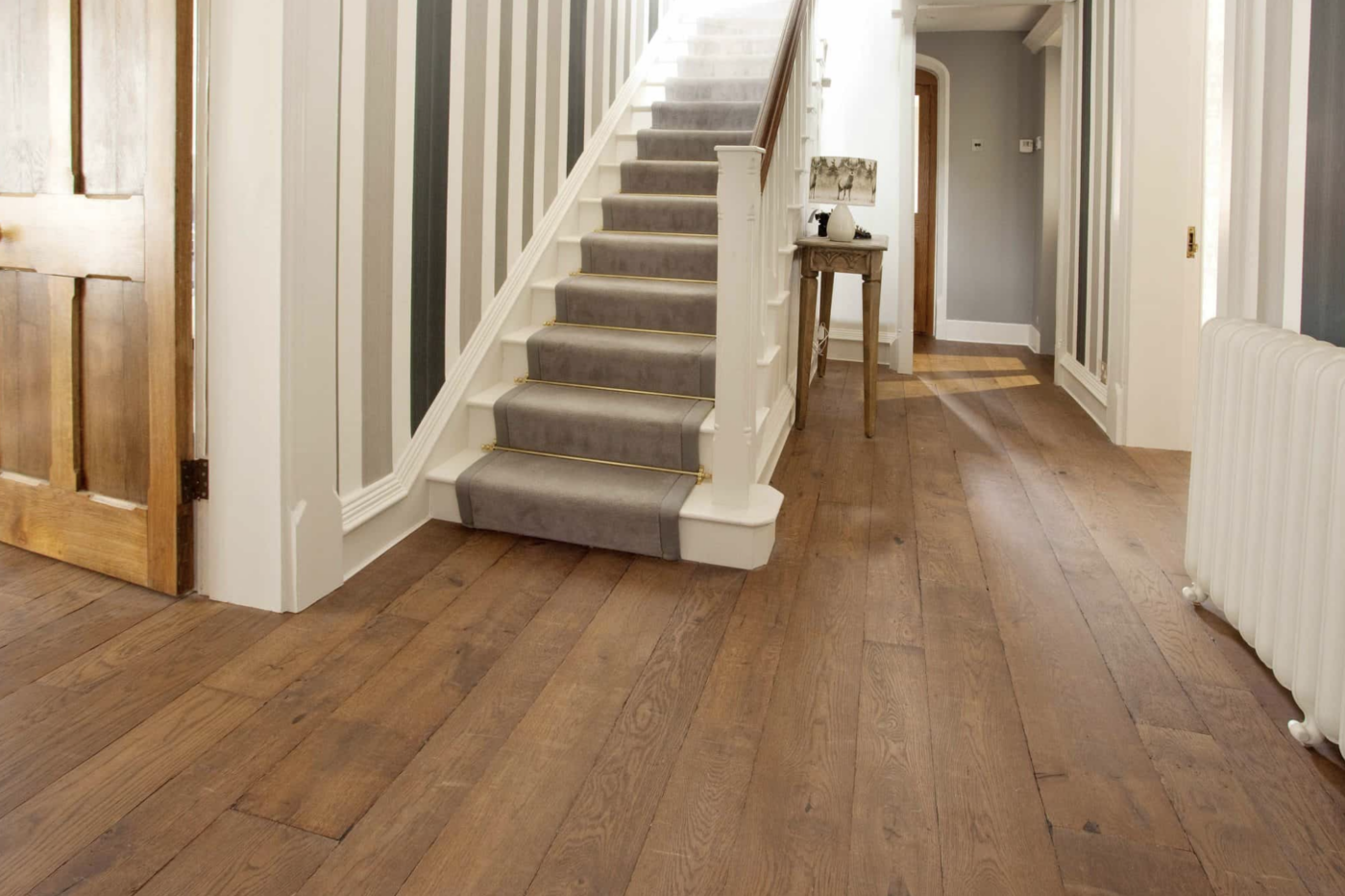
The warmth of the wood colour is echoed by the wooden doors, and the wide planks make an already-spacious hallway look even larger. What’s more, the wood flooring is laid in the hallway and extends into the rooms off the hallway, creating that all-important sense of flow. The richness of the wood colour adds a sense of rustic grandeur to the hallway; for guidance on choosing the right wood floor colour for your home, see our blog post.
We worked collaboratively with interior designer Charlotte Drinkall of Shere Madness on this Arts and Crafts mansion in Surrey (below). The residents chose several different types of flooring to strike an attractive balance between traditional style and contemporary elegance. One of their choices was herringbone flooring in a mid-toned shade. The quintessential choice for a large country property, herringbone flooring adds refinement to a space, and works well installed in entrance hallways and sweeping through to kitchens and reception rooms. Read our complete guide to herringbone flooring, then shop our range of this timeless flooring style.
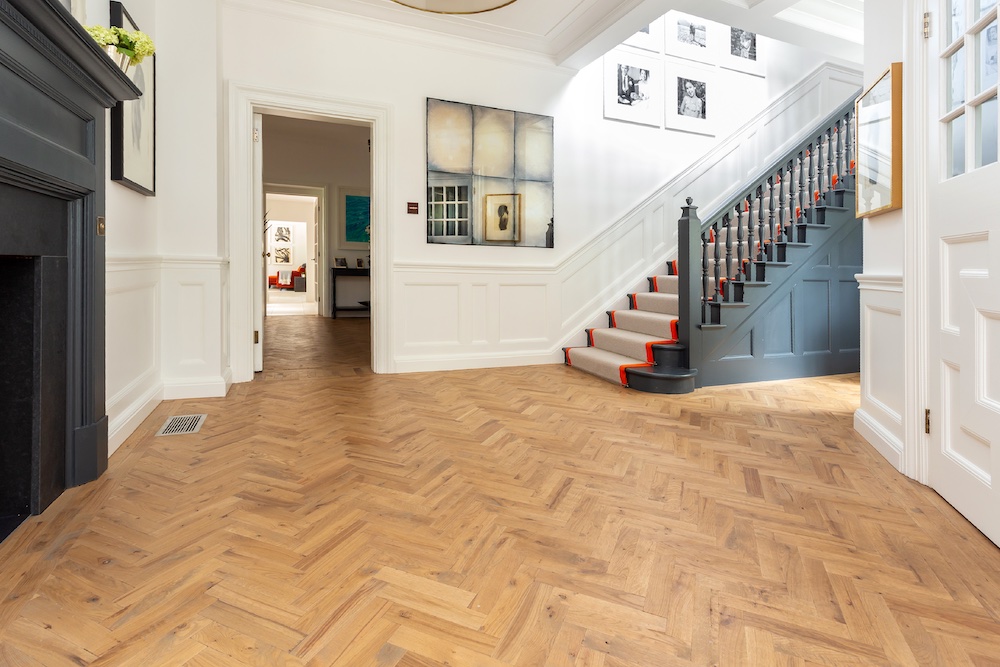
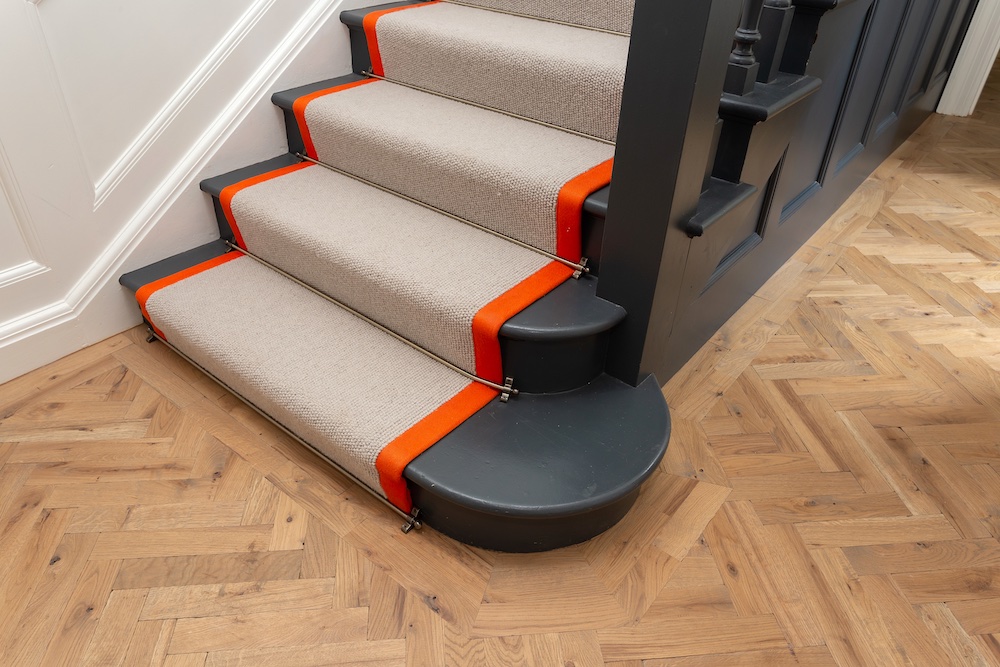
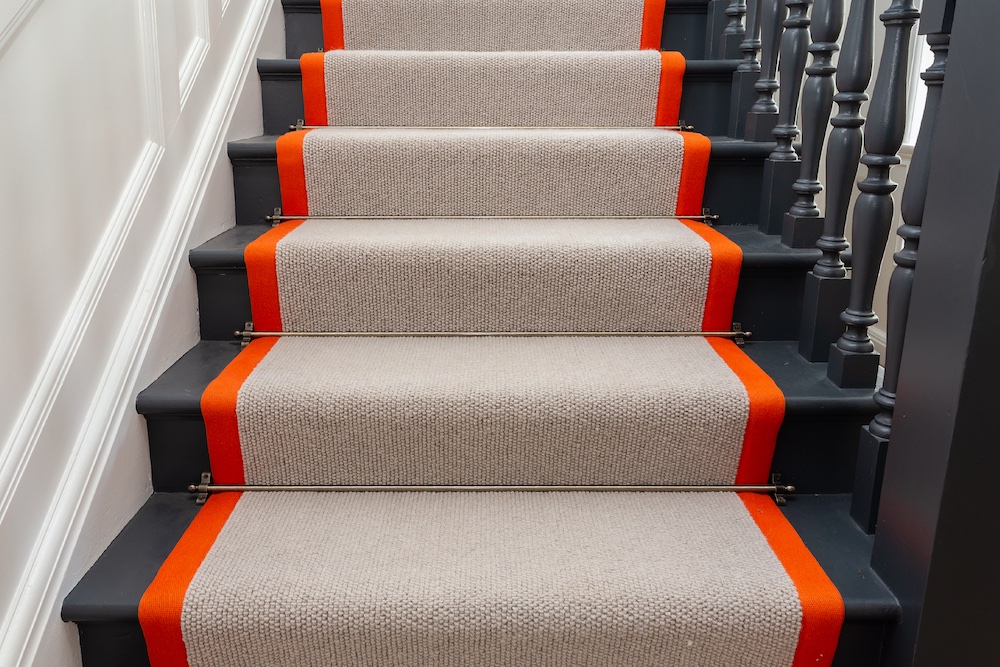
Elsewhere at this Arts and Crafts mansion, the residents made a standout feature of their staircase. They chose a dark grey paint for the stairs and added a contrasting runner in a pale shade, with a taped edge in vibrant orange for an eye-catching flash of colour. See our guide to pairing wood flooring with the perfect stair runner to create a similarly striking feature of your staircase.
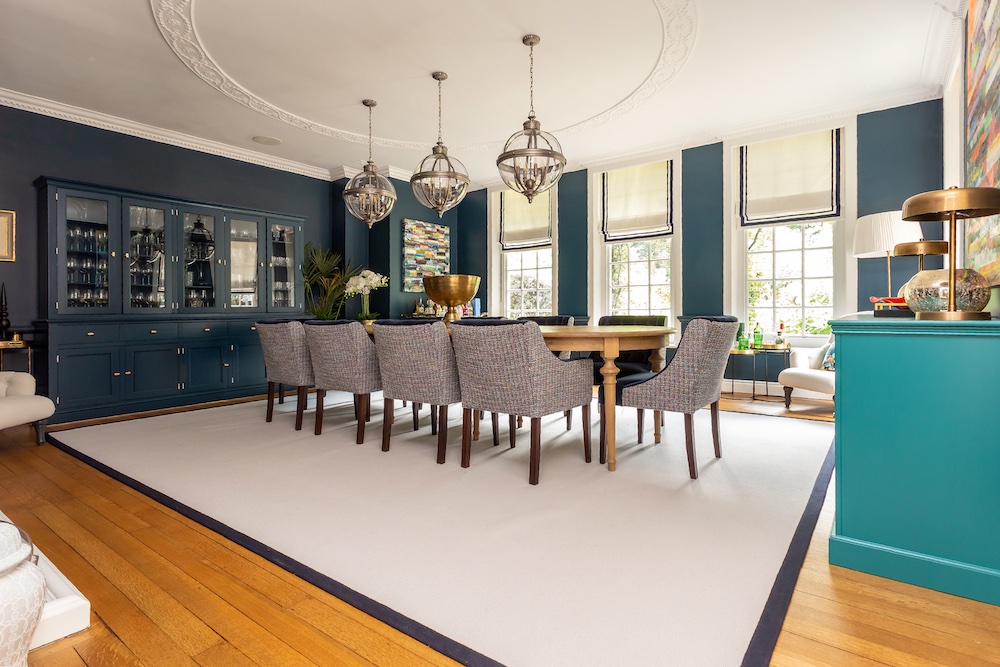
You can use your traditional wood floors to create a striking space for entertaining in a period home. Below, you’ll see the golden-toned wood flooring adds immediate warmth to a contrasting colour scheme of dark blue and white. The pale neutral shade of the rug further maximises the sense of space in a room that’s already large, and acts as a calming counterpoint to both the golden colours in the wood flooring and the strong blue shade of the walls.
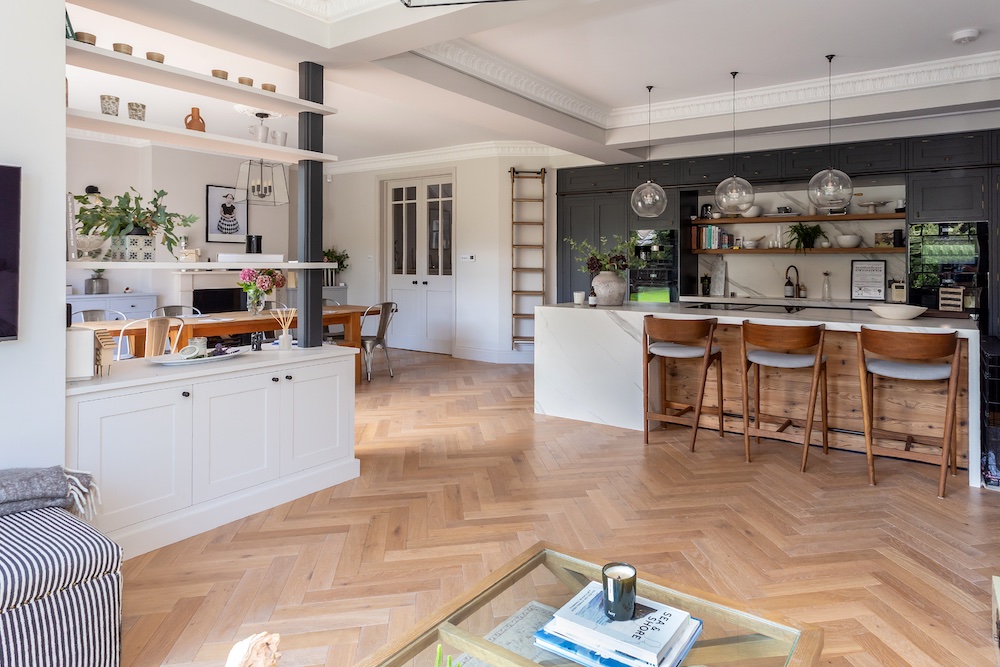
This home has a slightly more contemporary aesthetic overall, but classic details come in the form of the traditional wood floors chosen here. Herringbone flooring, again chosen in a mid-toned shade (not too light or too dark), adds a touch of heritage style to this otherwise modern kitchen.
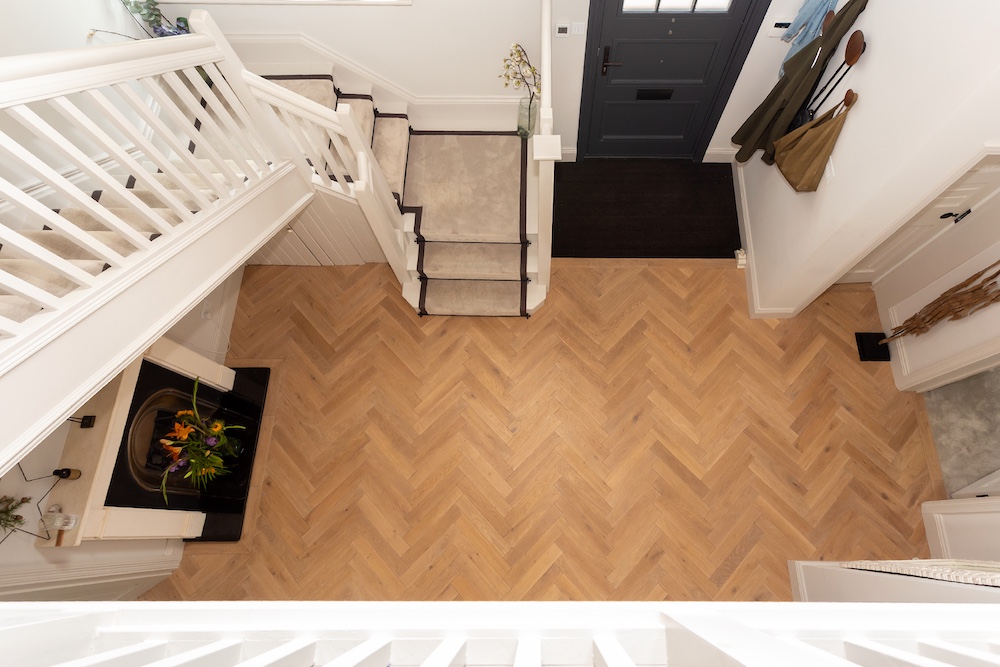
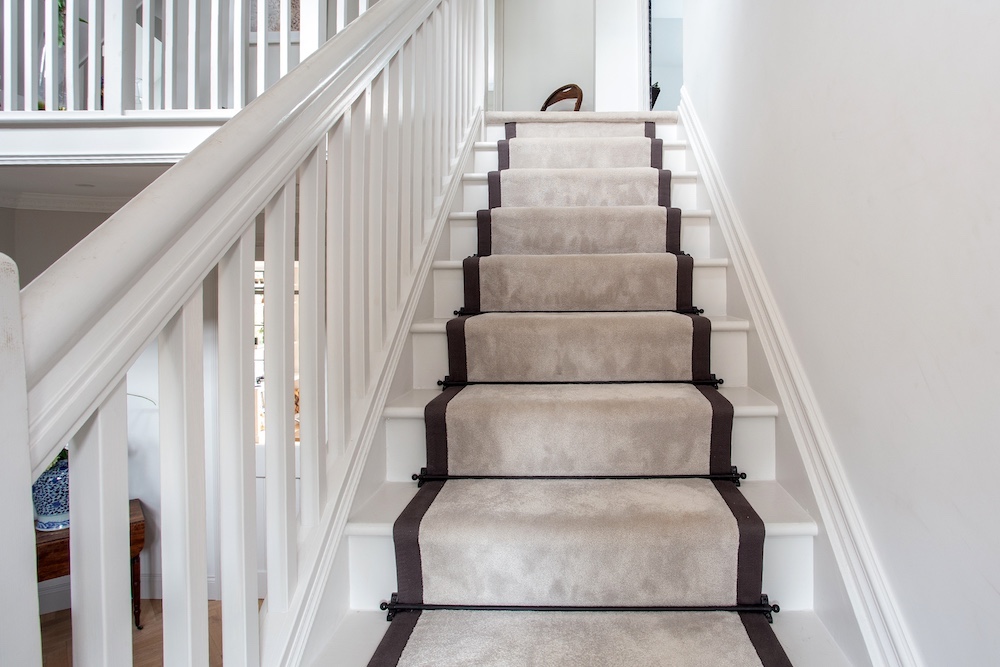
And this careful balancing of tradition and modernity is visible elsewhere in this house. Herringbone flooring is used to create a grand entrance hall, and then once again the staircase has been transformed into a standout feature. The white-painted wood stairs and pale carpet stair runner both work to add light to the stairwell, while the dark trim of the stair runner adds contrast and definition. Overall, the effect of the entrance and staircase together is one of expertly balanced tradition and timelessness.
Talk to us about wood flooring for your period home
For help and guidance in selecting the perfect traditional wood floors for your period home, get in touch with us. Our showroom in Camberley, Surrey, has 16 full-size room sets displaying more than 250 large-format wood flooring samples, and our flooring experts are on hand to assist you. If you’re unable to visit our showroom, we offer a sample service with free delivery so you can take a closer look at your choices and see how your selected wood flooring might look in your home before you make your purchase. And of course, if you have questions about wood flooring and just want to chat through your options, contact us via phone or email.